How to Patch Small Drywall Holes and Dents
Repair nail holes, screw holes, and small drywall dents with smooth filling, light sanding, primer, and matching paint.
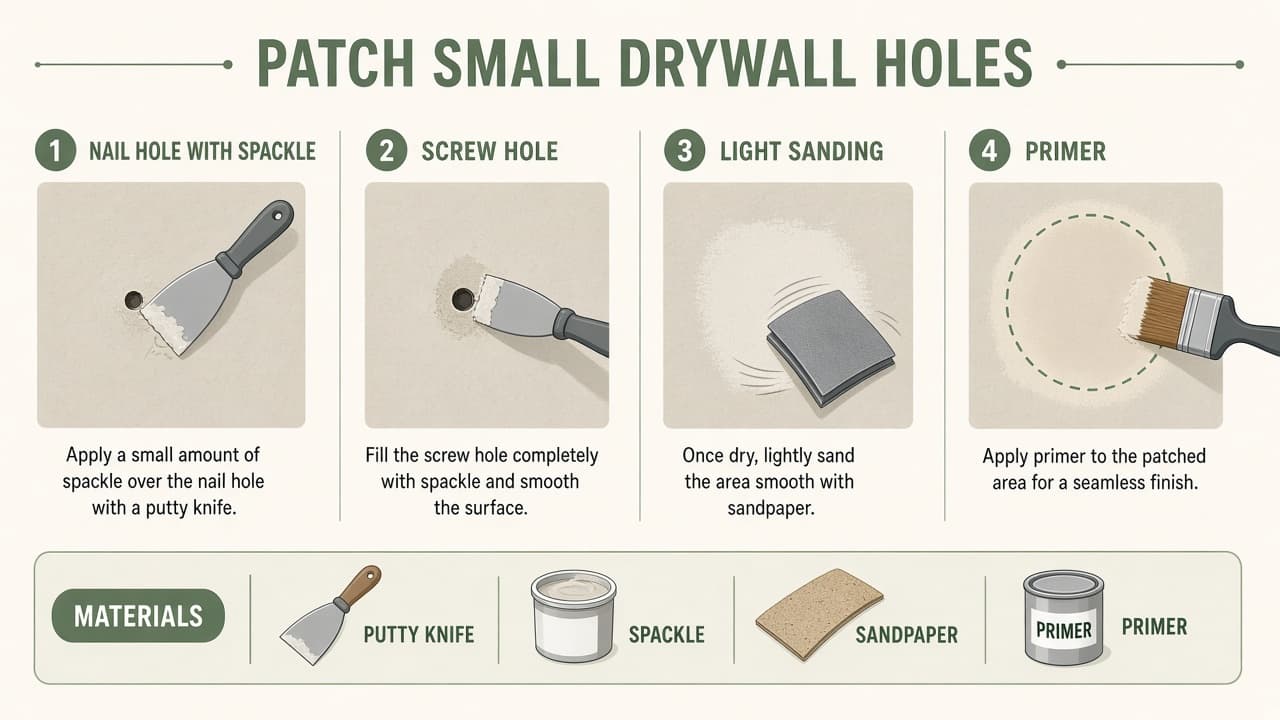
- Difficulty
- Beginner-friendly
- Time
- 1–3 hours plus drying time
- Est. cost
- $10–$40
- Season
- year round
By Keepstead Editorial Team · Published September 6, 2026 · 6 min read
Last reviewed September 6, 2026
Quick answer
For a nail hole, screw hole, or shallow dent, remove loose material, press in a thin coat of spackle, let it dry, sand lightly, spot-prime, and repaint. Use multiple thin coats instead of one thick mound. If drywall is missing, soft, wet, cracked repeatedly, or damaged beyond a small spot, use a supported patch or call a drywall professional.
Small drywall repairs are forgiving when the wall is dry and sound. The goal is not simply to fill the opening—it is to create a flat, feathered surface that does not flash through the paint.
For the rest of the room, follow interior paint preparation. If you need enough paint for a larger blend area, estimate it with the paint coverage calculator and room paint guide.
Decide whether the damage is small
| Damage | Typical approach |
|---|---|
| Pin or nail hole | Lightweight spackle |
| Screw hole with intact paper | Spackle in two thin coats |
| Shallow dent or gouge | Spackle, feathered beyond the dent |
| Hole about 1/2–6 inches | Mesh patch or supported drywall patch |
| Large opening, soft board, or repeated crack | Find the cause; repair framing/drywall professionally as needed |
A small hole near an outlet, switch, plumbing fixture, or wall-mounted appliance deserves extra caution. Do not insert a tool or screw into a cavity where hidden wiring or pipes may run.
Materials and tools
Tools needed
- Lightweight spackling or patching compound
- Flexible putty knife
- Fine sanding sponge, about 180–220 grit
- Damp microfiber cloth
- Stain-blocking or drywall primer
- Matching wall paint and small brush or roller
- Drop cloth
- Dust mask and eye protection
A broader putty knife makes feathering easier. Your beginner DIY tool kit covers useful basics, and the DIY PPE guide explains eye and dust protection.
Step 1: Check for moisture and movement
Before filling, ask why the damage exists.
- Brown staining, bubbling paint, softness, or mold odor suggests moisture.
- A crack that returns may indicate movement, a loose drywall seam, or framing issues.
- A popped screw may mean the fastener no longer holds the panel securely.
Fix leaks and structural causes before cosmetic patching. Compound over damp drywall will fail.
Step 2: Prepare the spot
- Protect the floor below the repair.
- Remove loose paint, fuzzy drywall paper, and crumbly gypsum with the edge of the putty knife.
- Press raised paper edges flat or trim only what is detached.
- Wipe away surface dust and let the area dry.
Do not enlarge a clean nail hole unnecessarily. For a screw hole, remove the old screw only if it is no longer supporting anything and you know it is safe to do so.
Step 3: Fill nail and screw holes
- Load a small amount of spackle on the knife.
- Press it firmly across the hole in two directions.
- Scrape the knife nearly flat to remove excess.
- Leave a very slight crown if the product shrinks as it dries.
- Let it dry for the full label time.
Deep screw holes may need a second coat. A thick blob dries slowly and is harder to sand flat.
Step 4: Fill a shallow dent
Spread compound beyond the edge of the dent. Hold the knife at a low angle and feather the outer edge so it transitions gradually into the painted wall.
For a deep gouge, build two or more thin coats. Let each coat dry completely before the next.
Step 5: Sand without hollowing the patch
Use a fine sanding sponge with light pressure:
- Sand the center until it is level.
- Feather the perimeter until you cannot feel an edge with your fingertips.
- Shine a work light across the wall to reveal ridges and pinholes.
- Wipe or vacuum dust before primer.
Do not over-sand into drywall paper. If the patch becomes hollow, add another thin coat and repeat.
Step 6: Prime the repair
Spot-prime the patch and a small margin around it. Bare compound is porous; paint applied directly over it can look dull, shiny, or differently textured.
Use a stain-blocking primer if the old damage left a dry, inactive stain. If a stain reappears, stop painting and find the moisture source.
Step 7: Paint and blend
Use the same color, sheen, and application texture as the existing wall. A miniature roller often blends roller stipple better than a brush.
| Existing finish | Blending approach |
|---|---|
| Flat paint in good condition | Spot painting may blend |
| Eggshell or satin | Feather a larger area |
| Dark or glossy color | Repaint to a corner for the most even result |
| Old or sun-faded paint | Expect color mismatch even with the original can |
Let primer and paint dry according to their labels. Judge the blend only after the finish coat has fully dried.
Common mistakes
- Filling over loose paint or drywall dust
- Applying one thick coat instead of thin layers
- Sanding before the center is dry
- Skipping primer
- Using a brush on a heavily rolled wall
- Patching active water damage
- Treating a moving crack as a cosmetic dent
When the hole is too large
Spackle does not provide structure. Move to a mesh or supported drywall patch when the opening is wider than a small fastener hole, the gypsum is missing, or the surrounding paper is torn.
Bottom line
Clean edges, thin coats, full drying, light sanding, primer, and matching paint make small drywall patches disappear. Do not use cosmetic filler to hide moisture, movement, missing board, or damage near utilities.
Frequently asked questions
- What should I use to fill nail holes in drywall?
- Lightweight spackling works well for clean nail holes and shallow dents. Use thin coats, let each coat dry, and sand lightly before priming and painting.
- Do I need to prime a small drywall patch before painting?
- Yes. Joint compound and spackle absorb paint differently from the surrounding wall. Spot-primer helps prevent a dull or shiny patch from showing through the finish coat.
- How large a drywall hole can I patch with spackle alone?
- Spackle alone is best for tiny fastener holes and shallow dents. Holes wider than roughly a half inch, torn paper, cracks that move, or missing drywall usually need a mesh patch or a supported drywall repair.
- Why can I still see the drywall patch after painting?
- The patch may be raised, not feathered widely enough, unprimed, or covered with paint that differs in sheen or color. Let it dry, sand the edges smooth, spot-prime, and repaint enough of the wall to blend.
Related guides
Interior Paint Prep: Walls, Trim & Ceilings
Clean, patch, sand, and prime where needed before rolling—what homeowners can prep safely and when to stop for pros.
How to Estimate Paint for a Room (Without Overbuying)
Measure paintable area, subtract doors and windows, account for coats and waste—then use our calculator or do the math manually before you buy.
Beginner DIY Tool Kit: What Homeowners Actually Need
Essential hand tools and safety gear for first-time homeowners—what to buy first, what to skip, and what to add as projects grow.
DIY Safety PPE: What Homeowners Actually Need
Eye, ear, hand, and lung protection matched to common homeowner tasks—from gutter work to filter changes—and where PPE isn't enough.
This guide is for general informational purposes. Conditions vary by home, local codes, and equipment. See our disclaimer.