Why Does My Circuit Breaker Keep Tripping?
Breaker keeps tripping? Diagnose overload, appliance fault, short circuit, GFCI/AFCI trips—and know when to stop resetting and call an electrician.
- Difficulty
- Beginner-friendly
- Time
- 10–20 minutes to diagnose
- Est. cost
- $0 (diagnosis only)
- Season
- year round
By Keepstead Editorial Team · Published August 29, 2026 · Updated September 6, 2026 · 9 min read
Last reviewed September 6, 2026
Quick answer
A one-time trip after plugging in too much on one circuit is often an overload—unplug devices, reset once. Repeated tripping, immediate re-trip, burning smell, or a warm panel/outlet means stop resetting and call an electrician. This guide covers safe homeowner checks only—never open an energized panel or replace breakers yourself.
A tripped breaker is doing its job: interrupting current when something is wrong. The question is whether it was a temporary overload you can fix—or a repeating fault that needs professional diagnosis.
For broader DIY boundaries, see when to call an electrician. If power is out at one receptacle but the breaker looks fine, start with what to do when an outlet stops working and GFCI testing and reset.
How circuit breakers work (30 seconds)
Breakers monitor current on a circuit. When current exceeds the rating (15A or 20A for most branch circuits) or when certain fault conditions occur, the breaker trips—cutting power.
| Breaker type | Protects against (generally) |
|---|---|
| Standard | Overload and short circuit |
| GFCI breaker | Ground faults (leakage to ground) |
| AFCI / CAFCI | Arc faults (damaged cords, some wiring faults) |
Tripping is protection, not annoyance—though nuisance tripping on AFCIs does happen with some loads. GFCI and AFCI devices may trip before or instead of a standard thermal breaker, which is why a “dead” room can look like a panel problem when the real fix is a RESET button.
Diagnostic table: pattern → meaning → action
| Pattern | Likely meaning | Homeowner action |
|---|---|---|
| Tripped once after space heater + microwave | Overloaded circuit | Reduce load; reset once |
| Trips every time one specific device runs | Appliance / cord fault | Stop using the device; repair or replace |
| Tripped once during a storm or brief surge, then holds | Temporary trip | Reset once; monitor—call pro if it repeats |
| Trips immediately on reset with nothing plugged in | Short circuit or bad breaker | Do not keep resetting—electrician |
| Trips repeatedly over days/weeks | Progressive fault or chronic overload | Electrician |
| Kitchen/bath outlets dead; breaker ON | GFCI protecting downstream outlets | Test/reset GFCI; see dead outlet |
| Trips with vacuum or older tool on bedroom circuit | Possible AFCI sensitivity | Try another circuit if appropriate; electrician if frequent |
| Burning smell, heat, scorch, buzzing | Serious hazard | Stop; electrician or emergency if fire/smoke |
Rule: Reset once after reducing load. If it trips again immediately or under normal use, stop resetting.
Cause-by-cause guide
Overloaded circuit (most common one-time trip)
Too much demand on one branch:
- Space heaters sharing a circuit with other high-draw devices
- Multiple kitchen countertop appliances at once
- Extension cords powering several loads
- Older homes where modern usage exceeds original design
What to do: Unplug or switch off high-draw devices. Spread loads across circuits. Space heaters and window AC units often need a dedicated circuit. Labeling which breaker feeds which rooms helps—see how to label your electrical panel.
Appliance or cord fault
One tool, heater, or appliance that trips the breaker every time it runs often has a damaged cord, internal short, or failing motor.
What to do: Leave that device unplugged. Test a known-good lamp or device on the same outlet. Do not keep forcing the breaker on with the suspect appliance connected.
Temporary / one-time trip
A single trip after a brief overload, a storm-related event, or a device startup surge can be temporary—if a careful reset holds and nothing feels hot or smells burnt.
What to do: Reduce load, reset once, restore devices one at a time, and watch for heat or smell. One clean reset that holds is different from a pattern of repeats.
Short circuit (treat as urgent)
A short creates a low-resistance path that can trip instantly—often with nothing (or almost nothing) plugged in after you unplug loads.
Warning signs: Immediate re-trip on reset; trip with all loads removed; damaged cords; water in an outlet or fixture; recent nail/screw into a wall near wiring.
What to do: Leave the breaker off. Do not diagnose inside walls or the panel. Call an electrician.
GFCI and AFCI relationship
| Situation | Often means | Start here |
|---|---|---|
| Outlets dead; breaker not tripped | Downstream GFCI tripped | GFCI reset guide |
| Only one outlet dead | GFCI, loose device, or local fault | Outlet stopped working |
| AFCI trips on certain motors | Nuisance or real arc signature | Different circuit if safe; electrician if persistent |
| GFCI/AFCI won’t reset | Fault still present or failed device | Electrician—do not bypass |
Never remove or bypass GFCI/AFCI protection to “stop the trips.” For a plain-language device comparison, see GFCI vs AFCI for homeowners. Undersized or daisy-chained extension cords can also contribute to overload trips—fix the cord before blaming the breaker.
Repeated trips
Tripping that returns after a successful reset—same day, same week, or every time a room is used—is not a finished diagnosis. Chronic overload, a failing breaker, loose connections, or a developing short can all look similar from outside the panel.
What to do: Document what was running, which breaker label tripped, and whether heat or smell was present. Then call a licensed electrician rather than resetting through the week.
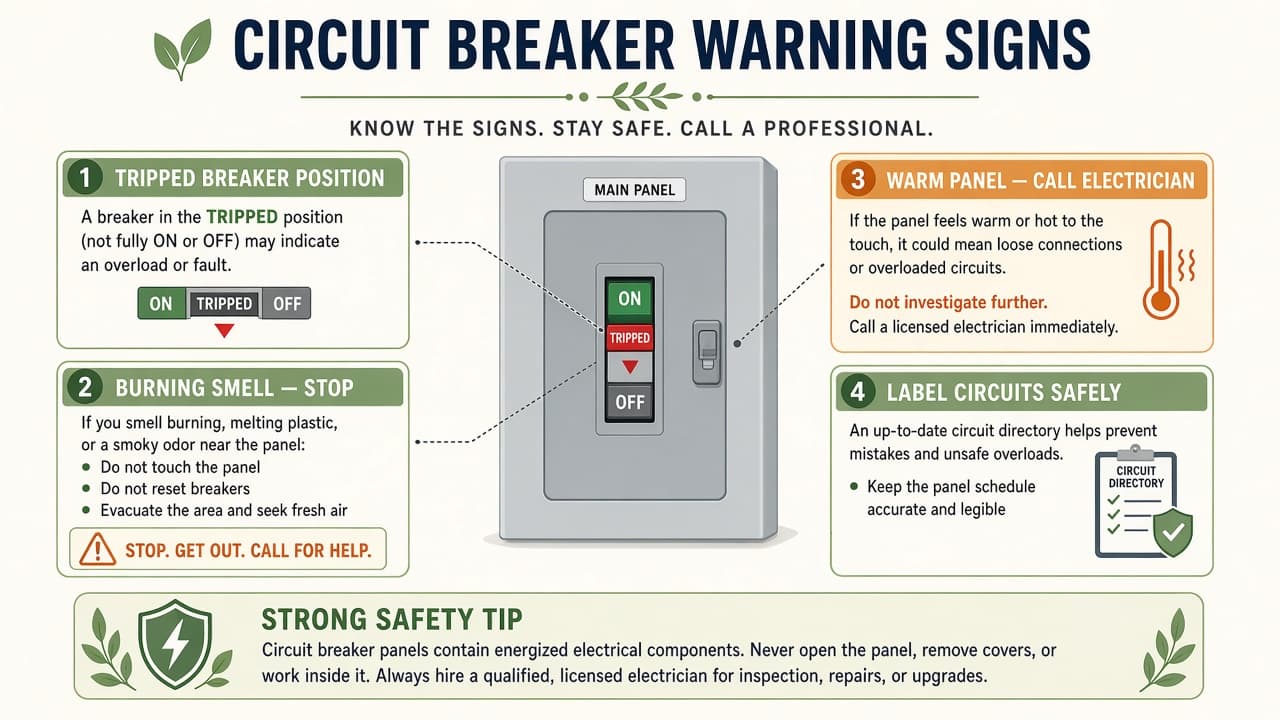
Burning smell, warm panel, or warm outlet
Heat and burnt-plastic or insulation odor are stop conditions, not “try again later” cues.
| Observation | Action |
|---|---|
| Warm breaker handle or panel front | Reduce load if safe; do not keep resetting; electrician |
| Warm or discolored outlet/faceplate | Stop using that outlet; electrician |
| Burning smell from panel, outlet, or device | Stop; electrician / emergency if smoke |
| Buzzing or crackling at panel | Leave area if unsafe; electrician |
Do not open the panel to “look for the hot spot.”
Safe reset procedure (cover closed)
- Identify what lost power — Walk the room; note lights and outlets that are off.
- Unplug or switch off devices on that circuit — Especially heaters, irons, and shop tools.
- Check GFCIs first if only receptacles died — Reset steps.
- Go to the panel — Stand on dry floor; use a flashlight if needed. Do not open the cover. Skip the reset if you see damage, scorch, or smell burning.
- Find the breaker in the middle or OFF position — Some brands trip to a center position.
- Firmly switch fully OFF, then ON — One deliberate motion. Do not hold it on.
- Wait and observe — Immediate re-trip → stop.
- Restore devices one at a time if the reset holds — Isolate a culprit appliance if trips return.
If you cannot tell which breaker feeds which area, use how to label your electrical panel when the system is stable—or hire a pro if the panel is damaged or unlabeled and confusing.
What homeowners can check vs must not DIY
| Check | How | Stop if |
|---|---|---|
| Overload | List high-draw devices on one circuit | Breaker trips again on reset |
| Faulty appliance | Test on another circuit / leave unplugged | Cord hot, cracked, or smelly |
| GFCI | Press RESET on protecting outlets | Won’t reset |
| Dead single outlet | Outlet checklist | Heat, burn marks, buzzing |
| Extension cords | Replace damaged cords; no daisy-chains | Cord warm under normal load |
| Panel labeling | Map breakers when system is calm | Panel damaged or hot |
| Do not DIY | Why |
|---|---|
| Opening the panel beyond a cover-closed reset | Shock / arc flash |
| Replacing breakers or adding circuits | Code and safety |
| Inspecting or splicing wall wiring | Hidden faults |
| Bypassing GFCI or AFCI | Removes life-safety protection |
| Diagnosing aluminum wiring or whole-house flicker | Specialist / electrician |
When to stop vs when to call an electrician
Stop resetting when:
- The breaker trips again immediately or soon after one careful reset
- You smell burning or feel unusual heat at the panel or an outlet
- Nothing is plugged in and it still trips
- You are unsure which breaker is safe to touch or the panel looks damaged
Bottom line
Treat a single trip as a possible overload you can correct. Treat repeated tripping, instant re-trips, heat, and burning smell as warnings—reset once (cover closed), then stop. Breakers protect your home from fire and shock; working around them defeats that protection.
Frequently asked questions
- Is it safe to reset a tripped breaker?
- Resetting once after unplugging devices on that circuit is normal. If the breaker trips again immediately or repeatedly, stop resetting and call an electrician—continued resetting can mask a serious fault.
- What's the difference between overload and a short circuit?
- An overload draws more current than the circuit is rated for (too many devices on one circuit). A short circuit is an unintended low-resistance path that can trip instantly and may indicate damaged wiring or a faulty device.
- Why does my AFCI breaker trip when I vacuum?
- Some motors and older appliances produce arc patterns that nuisance-trip AFCI breakers. Try another circuit or device—but if tripping is frequent, persistent, or accompanied by heat or smell, have an electrician evaluate rather than bypassing protection.
- My outlet died but the breaker looks fine—what next?
- Check GFCI outlets that may protect downstream receptacles, then confirm other outlets on the same wall. Use our dead-outlet checklist before assuming a panel problem.
Sources & references
Related guides
When Should You Call an Electrician?
Not sure what's safe to DIY electrically? See what's usually OK for homeowners, what needs a licensed electrician, and how permits work.
How to Test and Reset a GFCI Outlet
Test GFCI outlets monthly, reset after a trip, and know why a GFCI keeps tripping or won't reset—plus when to call an electrician.
What to Do When an Outlet Stops Working
Safe homeowner checks when one outlet stops working—GFCI reset, breaker, other outlets on the circuit—and clear limits before calling an electrician.
How to Label an Electrical Panel Safely
Map and label electrical panel circuits one at a time with a helper, record what each breaker controls, and know when to call an electrician.
This guide is for general informational purposes. Conditions vary by home, local codes, and equipment. See our disclaimer.