GFCI vs AFCI: A Homeowner's Guide
Compare GFCI and AFCI protection—what each guards against, where you find them, how TEST buttons differ, and when to call an electrician.
- Difficulty
- Beginner-friendly
- Time
- 10 minutes to read
- Est. cost
- $0 (education only)
- Season
- year round
By Keepstead Editorial Team · Published September 6, 2026 · 5 min read
Last reviewed September 6, 2026
Quick answer
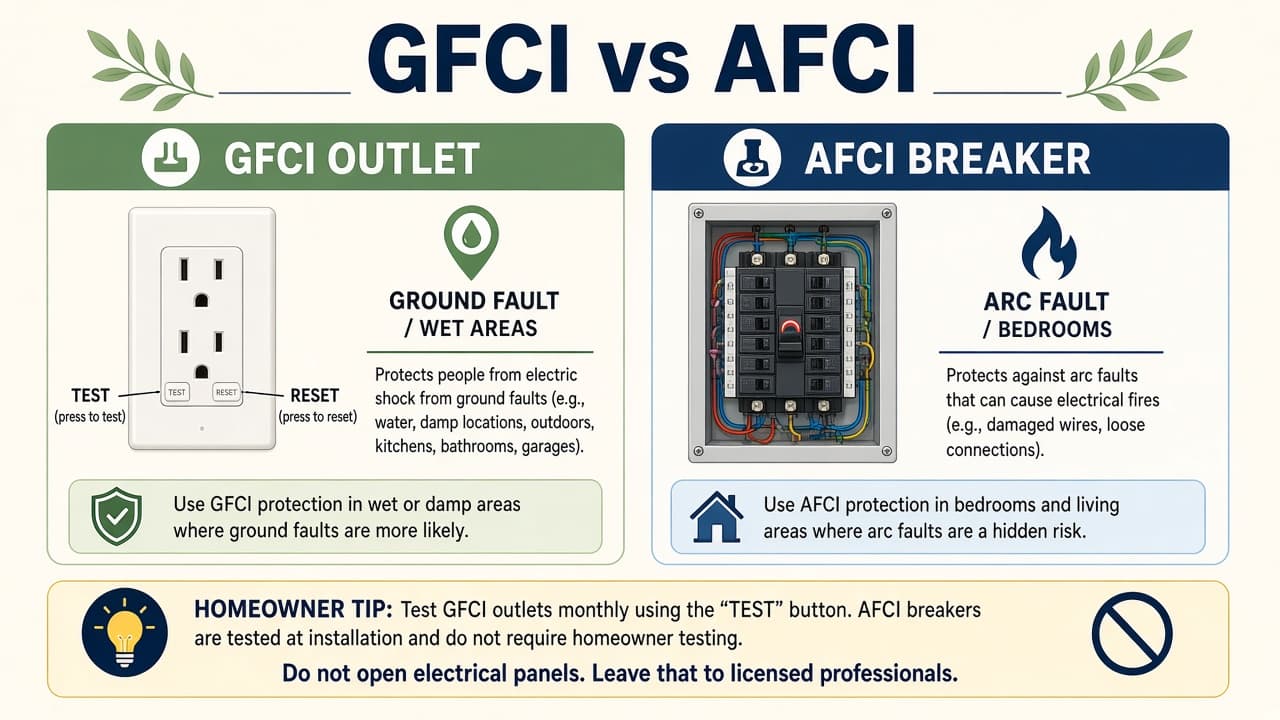
GFCI cuts power on a ground fault (shock protection near water). AFCI cuts power on a dangerous arc (fire protection on many living-area circuits). They are not interchangeable. Test GFCI outlets monthly with the face buttons—full steps in how to test GFCI outlets. Do not open the electrical panel to “try” breakers.
GFCI and AFCI labels show up on outlets and breakers, and it is easy to treat them as generic “safety switches.” They solve different problems. Knowing which is which helps you interpret a dead outlet or a breaker that keeps tripping—and keeps you from bypassing protection that is doing its job.
This guide is a comparison for homeowners. It is not wiring instruction, breaker replacement, or panel work. For DIY limits, see when to call an electrician.
Side-by-side comparison
| GFCI (Ground Fault Circuit Interrupter) | AFCI (Arc Fault Circuit Interrupter) | |
|---|---|---|
| Main hazard addressed | Shock from current leaking to ground (often via water or a person) | Fire from arcing in damaged cords or wiring |
| Typical “signature” | Imbalance between hot and neutral current | Arc patterns the device is designed to detect |
| Common locations | Kitchens, baths, garages, outdoors, laundry, unfinished basements | Bedrooms and many living areas (per era of code); often as breakers |
| Homeowner-visible form | Outlet with TEST/RESET, or GFCI breaker | Usually a breaker (sometimes combo devices); rarely a standard look-alike outlet |
| TEST / RESET on outlet face | Yes on GFCI receptacles | Not the same monthly outlet routine |
| Does it replace the other? | No | No |
| Homeowner DIY focus | Monthly outlet test/reset (linked guide) | Recognize trips; do not open panel to reconfigure |
Combination GFCI/AFCI breakers exist in some panels. Labels matter—read the handle text rather than assuming every “extra button” breaker is the same.
Where you usually find each
GFCI protection shows up where water and electricity meet:
- Bathroom vanity outlets
- Kitchen countertop circuits
- Garage and exterior receptacles
- Laundry and utility areas
- Unfinished basements and near pools/spas (treat as critical)
One GFCI outlet can protect downstream standard outlets on the same circuit. A dead bath outlet with no buttons may still be tied to a GFCI elsewhere—see outlet stopped working.
AFCI protection is more often a breaker serving bedrooms and other living spaces, depending on when the home was wired or updated. You may notice trips when a vacuum, space heater, or damaged cord runs on that circuit—patterns covered in why a circuit breaker keeps tripping.
TEST buttons: what homeowners should (and shouldn’t) do
GFCI outlets
GFCI receptacles have TEST and RESET on the face. Pressing TEST should cut power; RESET restores it. That monthly check confirms the device still works.
Do not duplicate the full procedure here. Follow the owner guide:
→ How to test and reset a GFCI outlet
If TEST does nothing, RESET will not hold, or the device trips with nothing plugged in, stop using it and call an electrician.
AFCI (and GFCI) breakers
Breakers may include a test function on the breaker body. Homeowners should not remove the panel cover, touch bus bars, or replace breakers. If a labeled AFCI/GFCI breaker trips repeatedly, treat it like any repeating trip: reduce load once, then call a pro rather than forcing resets. See circuit breaker keeps tripping and when to call an electrician.
How this shows up in real homes
| Situation | Think… | Next step |
|---|---|---|
| Kitchen outlet dead; bath still live | Possible GFCI trip on that kitchen device or a shared protected leg | Test/reset GFCI |
| Bedroom circuit trips with a vacuum | Possible AFCI sensitivity or cord/arc issue | Try another circuit if appropriate; electrician if frequent |
| Outdoor outlet won’t reset after rain | GFCI doing its job or a wet fault | Unplug loads; dry area; electrician if it won’t hold |
| Burning smell or warm device | Hazard, not a label debate | Stop; call electrician (emergency services if smoke/fire) |
When to call an electrician
Bottom line
GFCI ≈ shock protection near moisture. AFCI ≈ arc/fire protection on many living-area circuits. Use the right mental model, test GFCI outlets on the schedule in our GFCI test guide, and leave panel and device replacement to licensed help.
Frequently asked questions
- Is GFCI the same as AFCI?
- No. GFCI devices protect against ground faults (shock risk, especially near water). AFCI devices protect against arc faults (a fire risk from damaged cords or wiring). Homes often need both types in different locations.
- Can I test an AFCI the same way as a GFCI outlet?
- Not with the outlet face buttons you use on a GFCI receptacle. Many AFCI devices are breakers in the panel with their own test function—homeowners should not open panels to experiment. For GFCI outlets, use our monthly test guide.
- Why did my bedroom breaker trip but the kitchen GFCI is fine?
- Different devices protect different hazards and circuits. An AFCI bedroom breaker can trip on an arc signature while kitchen GFCIs remain reset. Treat repeated trips as a reason to call an electrician—not a reason to swap breaker types yourself.
Sources & references
Related guides
How to Test and Reset a GFCI Outlet
Test GFCI outlets monthly, reset after a trip, and know why a GFCI keeps tripping or won't reset—plus when to call an electrician.
Why Does My Circuit Breaker Keep Tripping?
Breaker keeps tripping? Diagnose overload, appliance fault, short circuit, GFCI/AFCI trips—and know when to stop resetting and call an electrician.
What to Do When an Outlet Stops Working
Safe homeowner checks when one outlet stops working—GFCI reset, breaker, other outlets on the circuit—and clear limits before calling an electrician.
When Should You Call an Electrician?
Not sure what's safe to DIY electrically? See what's usually OK for homeowners, what needs a licensed electrician, and how permits work.
This guide is for general informational purposes. Conditions vary by home, local codes, and equipment. See our disclaimer.