Low Water Pressure Troubleshooting for Homeowners
Weak flow from one faucet or the whole house? Check aerators, shutoffs, and municipal notices before calling a plumber—safe homeowner steps only.
- Difficulty
- Beginner-friendly
- Time
- 15–30 minutes
- Est. cost
- $0–$10 (vinegar / replacement aerator)
- Season
- year round
By Keepstead Editorial Team · Published September 6, 2026 · 5 min read
Last reviewed September 6, 2026
Quick answer
Start by asking: one fixture or the whole house? One faucet with weak spray is often a clogged aerator or a shutoff left partly closed. Whole-house low pressure may be a municipal issue, a nearly closed main shutoff, or a problem that needs a plumber. This guide is diagnosis—not leak repair.
Low water pressure and a dripping faucet are different problems. A drip when the handle is off is usually seals or a cartridge—see leaky kitchen faucet repair. Weak, sputtering, or thin flow when water is on is a pressure or restriction issue. Treat them separately so you do not replace parts that are not the cause.
Symptom table: what to check first
| Symptom | Likely cause | Homeowner first step |
|---|---|---|
| Weak or uneven spray at one faucet, water on | Clogged aerator | Clean or replace aerator |
| Low flow after recent faucet work | Debris in aerator; shutoff not fully open | Clean aerator; open under-sink valves fully |
| Only hot (or only cold) is weak at one sink | One angle stop partly closed; debris in that line | Open that shutoff fully; flush after cleaning tip |
| One bathroom or kitchen only | Local shutoffs or fixture restriction | Check local valves; compare other rooms |
| Whole house suddenly weak | Municipal work/notice; main valve position | Check utility alerts; verify main shutoff is fully open |
| Whole house gradually weaker over months | Supply, meter, PRV, or scale issues | Document fixtures affected; call plumber |
| Low flow and drip when off | Two issues possible | Fix leak path separately from flow path |
Step 1: One fixture vs whole house
Run water at two or three fixtures in different rooms (kitchen sink, bathroom sink, tub or shower).
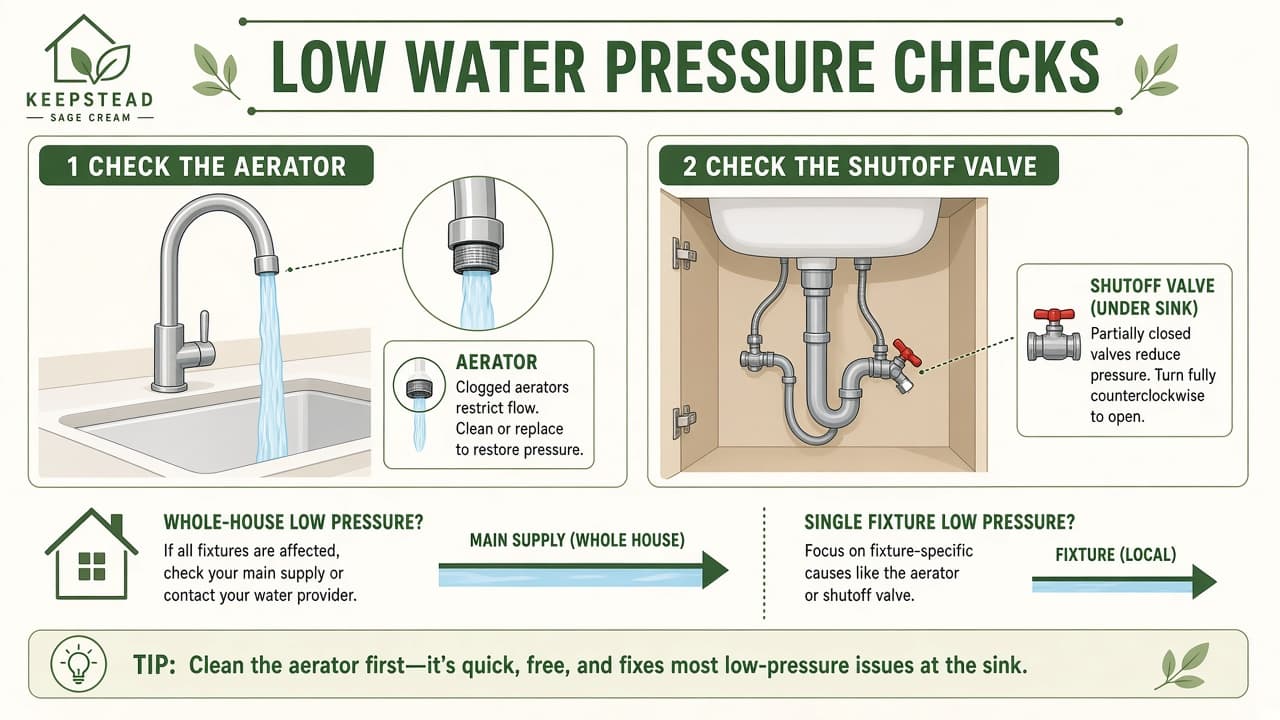
- One fixture only — Stay local: aerator, pop-up debris, under-sink shutoff valves, supply connectors.
- Several fixtures in one area — Check shared shutoffs or a branch you recently touched.
- Every fixture — Check municipal notices, then the main shutoff position, then consider professional help.
Also note whether hot only, cold only, or both are weak. That single detail often points to one angle stop or one side of a mixing fixture.
Step 2: Safe homeowner checks (no pipe cutting)
- Clean the aerator on the weak faucet — Mineral scale and grit clog the tip and mimic low pressure. Full steps: how to clean a faucet aerator.
- Open under-sink shutoffs fully — Multi-turn valves usually open counterclockwise until they stop gently. Lever (quarter-turn) valves are open when the handle lines up with the pipe. Do not force a seized valve.
- Confirm you did not leave a valve half-closed after a repair — Common after cartridge swaps and supply-line work.
- Check other fixtures for comparison — Same weakness everywhere changes the diagnosis.
- Look for utility or municipal notices — Hydrant flushing, main breaks, and planned work can drop neighborhood pressure temporarily. Check your water utility website, app, or neighborhood alerts.
Step 3: Main shutoff position (whole-house cases)
If pressure is low everywhere, visually confirm the main water shutoff is fully open. Someone may have closed it partly during a repair, freeze scare, or vacation prep and never reopened it fully.
Know where the main is before an emergency. Testing a sticky main valve casually is not required for this diagnosis—if you are unsure how yours operates, stop at identification and call a pro rather than experimenting during low-pressure troubleshooting.
What this guide is not
- Not faucet leak repair — Drips, base leaks, and under-sink wetness belong in the leaky kitchen faucet guide.
- Not pressure-reducing valve (PRV) adjustment — Many homes have a PRV near the main; adjusting or replacing it is plumber territory.
- Not well-pump diagnosis — Private wells involve tanks, switches, and electrical controls—hire qualified help.
When to call a plumber
Bottom line
For one weak faucet, clean the aerator and open local shutoffs. For the whole house, check utility notices and main-valve position, then escalate. Keep leak repair and pressure troubleshooting on separate tracks so you fix the symptom you actually have.
Frequently asked questions
- Why is water pressure low in only one faucet?
- One-fixture problems are often a clogged aerator, partially closed under-sink shutoffs, or a restricted supply line at that fixture—not a whole-house pressure failure. Clean the aerator and confirm both hot and cold angle stops are fully open before assuming a larger issue.
- Can a recent faucet repair cause weak flow?
- Yes. Debris can lodge in the aerator after cartridge work, or a supply shutoff may have been left partly closed. Check those first—see our aerator cleaning guide—rather than treating it as a new leak problem.
- Does low pressure always mean I need a plumber?
- Not always. Many one-faucet cases resolve with aerator cleaning or opening shutoffs. Whole-house drops, sudden loss with no municipal notice, or pressure that stays low after simple checks warrant a plumber.
Related guides
How to Clean a Faucet Aerator
Unscrew and clean a clogged faucet aerator to fix weak spray, uneven flow, or mineral buildup—without replacing the whole faucet.
How to Find Your Main Water Shutoff Valve
Locate your home's main water shutoff—basement, crawl space, slab, or meter—and know when to use it vs under-sink shutoffs before a leak emergency.
How to Fix a Leaky Kitchen Faucet (Spout, Handle, Base & Under Sink)
Kitchen faucet leak repair: find the drip at spout, handle, base, or supply line—then replace the right part or know when to call a plumber.
When Should You Call a Plumber Instead of DIY?
Toilet running, slow drain, or leak at the wall? See which plumbing jobs are safe DIY—and which need a licensed plumber before you start.
This guide is for general informational purposes. Conditions vary by home, local codes, and equipment. See our disclaimer.