How to Find Your Main Water Shutoff Valve
Locate your home's main water shutoff—basement, crawl space, slab, or meter—and know when to use it vs under-sink shutoffs before a leak emergency.
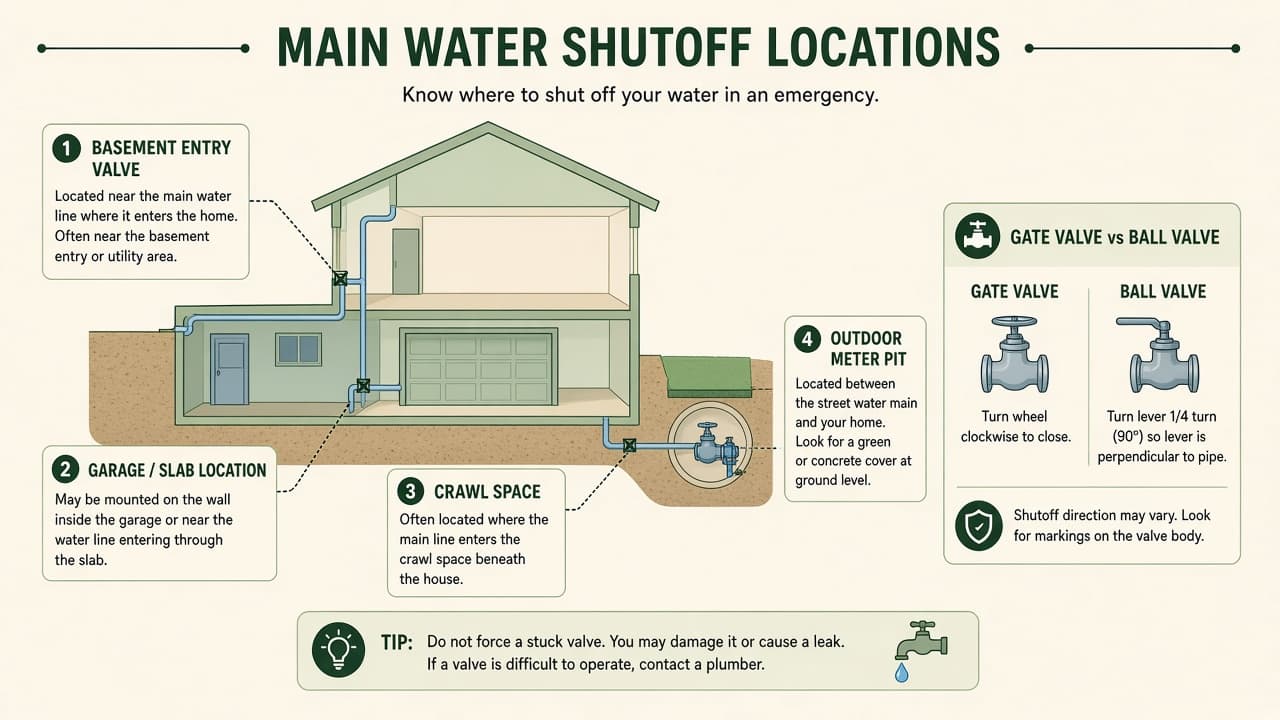
- Difficulty
- Beginner-friendly
- Time
- 10 minutes to read
- Est. cost
- Free (locating valve only)
- Season
- year round
By Keepstead Editorial Team · Published August 29, 2026 · Updated September 6, 2026 · 7 min read
Last reviewed September 6, 2026
Quick answer
Find where the water service line enters the house—basement, crawl space, utility closet, or garage—and look for a gate valve (round handle) or ball valve (lever) on the main line. Test it once, label it, and tell everyone in the home. If the house valve fails, learn the meter or curb stop location. Pair with frozen pipe prep and plumber vs DIY guidance.
When a supply line bursts or a toilet overflows, stopping water at the source limits damage. The main shutoff is the fastest way to cut water to the whole house—if you know where it is and it still turns.
Emergency procedure (when water is spraying)
Practice this order on a calm day so you do not invent it during a flood:
- Go to the main shutoff — Not the fixture stop if water is pouring from a pipe, ceiling, or unknown source.
- Close the valve — Gate: clockwise until firm. Ball: lever perpendicular to the pipe.
- Relieve pressure — Open a cold faucet at a low level so water in the lines drains.
- Stay clear of electricity — Do not wade to outlets or a wet panel.
- Call for help — Follow the burst pipe emergency checklist; call a plumber for pipe repair.
Fixture drips (leaky kitchen faucet, toilet fill valve) usually use local stops first—use the main when those fail or the leak is whole-house.
Main Shutoff vs Under-Sink Shutoff — Which Do You Need?
| Shutoff | What it stops | Use when |
|---|---|---|
| Fixture angle stop (under sink / behind toilet) | One faucet or toilet | Localized repair—e.g. leaky kitchen faucet or fill valve replacement |
| Appliance / fixture shutoffs | One appliance or outdoor bib | Inventory valves with the appliance shutoff guide; use for water heater leaks when the unit shutoff works; winterize outdoor faucets before freeze season |
| Main house shutoff | Entire home water supply | Burst pipe, failed fixture valves, flooding, or you cannot find/operate a local stop |
| Meter / curb stop | Service at the street or meter | House valve failed or inaccessible; follow utility rules |
Fixture shutoffs are convenient but can seize or leak when turned. The main valve is your reliable backstop—know it before you need it for running toilet work, sump pump flood prep, or emergencies.
Why locate it before an emergency
- Burst pipes and failed fittings release water continuously
- Appliance supply hoses can dump gallons per minute
- Frozen pipes that split need immediate shutoff
- Even small faucet leaks are easier when water is off
- Before travel, practice the valve and follow the vacation home shutdown checklist
Walk through this once on a calm weekend—not at 2 a.m. during a flood.
Where to look by home type
| Home type | Common locations |
|---|---|
| Basement | Pipe entering foundation wall; valve within a few feet of the entry |
| Crawl space | Near front wall where service enters; bring a flashlight and mark the path |
| Slab foundation | Garage wall penetration, utility closet near front door, or meter pit outside |
| Condo / apartment | Utility closet; sometimes a unit shutoff plus a building main—ask management before operating shared valves |
| Utility / mechanical room | Near water heater or furnace on the cold inlet side |
Follow the largest cold water pipe from the street side of the house. The main valve is usually before branches to fixtures.
How to identify the main valve
| Clue | What it means |
|---|---|
| Largest cold line near foundation entry | Likely the service main |
| Valve before branches to sinks/toilets | House main (not a fixture stop) |
| Round wheel handle | Gate valve—several clockwise turns to close |
| Lever handle | Ball valve—perpendicular = off |
| Small valves under a sink or behind a toilet | Fixture stops—not the main |
Label clearly: MAIN WATER OFF. Do not confuse outdoor hose bibs or water-heater drain valves with the house main.
Valve types
Gate valve — round wheel handle; turn clockwise to close (righty-tighty). May need several turns.
Ball valve — lever handle; perpendicular to pipe = off, parallel = on.
Older valves may be stiff or corroded. Turn gently. If handle spins without stopping flow, call a plumber—do not break the stem.
Stuck, frozen, or seized shutoff
| Problem | What to do |
|---|---|
| Stiff but moves slightly | Try steady, light turns—do not yank |
| Will not budge | Leave it; go to meter/curb stop or call a plumber |
| Handle spins, water still flows | Stem failed—main is not closing; call a plumber |
| Valve leaks when you operate it | Schedule replacement soon; know meter backup |
| Outdoor valves freeze in winter | Winterize outdoor faucets; protect exposed mains where climate requires |
A stuck valve discovered on a Saturday is inconvenient. The same valve discovered during a burst pipe is an emergency—test once now.
Water meter and curb stop
Some homes have a shutoff at the meter in a pit near the sidewalk or at the property line. A curb stop may require a meter key or special wrench—check with your water utility about homeowner operation rules.
If the house valve is inaccessible or failed, the meter stop may be the backup—know this before you need it.
Quick location checklist
- Found indoor main valve (or confirmed meter/curb location)
- Identified gate vs ball valve
- Tested close/open once (with household notice)
- Labeled MAIN WATER OFF
- Flashlight / wrench stored nearby if needed
- All adults in home know the location
- Know which appliance and fixture stops exist for routine repairs
Test the valve safely
- Notify household members water will be off briefly.
- Turn valve off.
- Open a lowest-level cold faucet to relieve pressure.
- Confirm water stops at another fixture.
- Turn valve on slowly and check for leaks at the valve packing.
If the valve will not fully close, schedule replacement—do not wait for an emergency.
Label and equip
- Tag the valve: MAIN WATER OFF
- Hang a flashlight nearby in dark crawl spaces
- Store a adjustable wrench if required for meter nut
- Add shutoff location to your annual maintenance notes
When to call a plumber
- Valve broken, seized, or leaking when operated
- Cannot locate any shutoff
- Need curb stop operated and utility policy restricts DIY
- After shutoff, pressure remains—possible bypass or valve failure
See when to call a plumber vs DIY for leak response boundaries.
Related emergencies
Practice shutoff location alongside:
- Burst pipe / flood emergency checklist
- Appliance and fixture shutoff inventory
- Leaky kitchen faucet and toilet fill valve repairs with local stop
- Running toilet work when the angle stop fails
- Winter freeze preparation and outdoor faucet winterizing
Knowing the main valve turns a plumbing problem into a controlled repair instead of a renovation.
Frequently asked questions
- Where is the main water shutoff usually located?
- Often near where the water line enters the house—basement, crawl space, utility room, or garage. Some homes have a shutoff at the water meter or a curb box at the street.
- Which way do I turn the valve to shut off water?
- Gate valves typically turn clockwise to close. Ball valves with a lever are off when the handle is perpendicular to the pipe. Turn gently—old valves can break if forced.
- Should everyone in the household know where the shutoff is?
- Yes. Label the valve, show all adults and responsible teens, and keep a wrench nearby if the valve requires one. Seconds matter during a burst pipe or major leak.
- When do I use the main shutoff instead of under-sink valves?
- Use under-sink or toilet angle stops for a single fixture repair when they work. Use the main shutoff for burst pipes, failed fixture shutoffs, whole-house leaks, or when you cannot stop water at the fixture.
- What if the main shutoff is stuck or frozen?
- Do not force it—stems can snap. Try the meter or curb stop only if your utility allows, then call a plumber for valve replacement. Know both locations before an emergency.
Sources & references
Related guides
When Should You Call a Plumber Instead of DIY?
Toilet running, slow drain, or leak at the wall? See which plumbing jobs are safe DIY—and which need a licensed plumber before you start.
Appliance Shutoff Valves: A Homeowner's Guide
Find and identify shutoff valves for washers, dishwashers, refrigerators, water heaters, toilets, and sinks before a leak.
How to Winterize Outdoor Faucets
Disconnect hoses, shut off and drain outdoor faucets, understand frost-free models, and protect plumbing before freezing weather.
Water Heater Leaking: What to Do First
Find where a water heater is leaking, shut it down safely, limit damage, and tell when a fitting or failed tank needs a plumber.
This guide is for general informational purposes. Conditions vary by home, local codes, and equipment. See our disclaimer.