Why Your Toilet Keeps Running (Causes & Diagnosis)
Diagnose a running toilet—flapper, fill valve, float, overflow, chain, and handle—with a symptom table and links to the right repair guide.
- Difficulty
- Beginner-friendly
- Time
- 10–20 minutes to diagnose
- Est. cost
- $0 (diagnosis only)
- Season
- year round
By Keepstead Editorial Team · Published January 18, 2026 · Updated September 6, 2026 · 4 min read
Last reviewed September 6, 2026
Quick answer
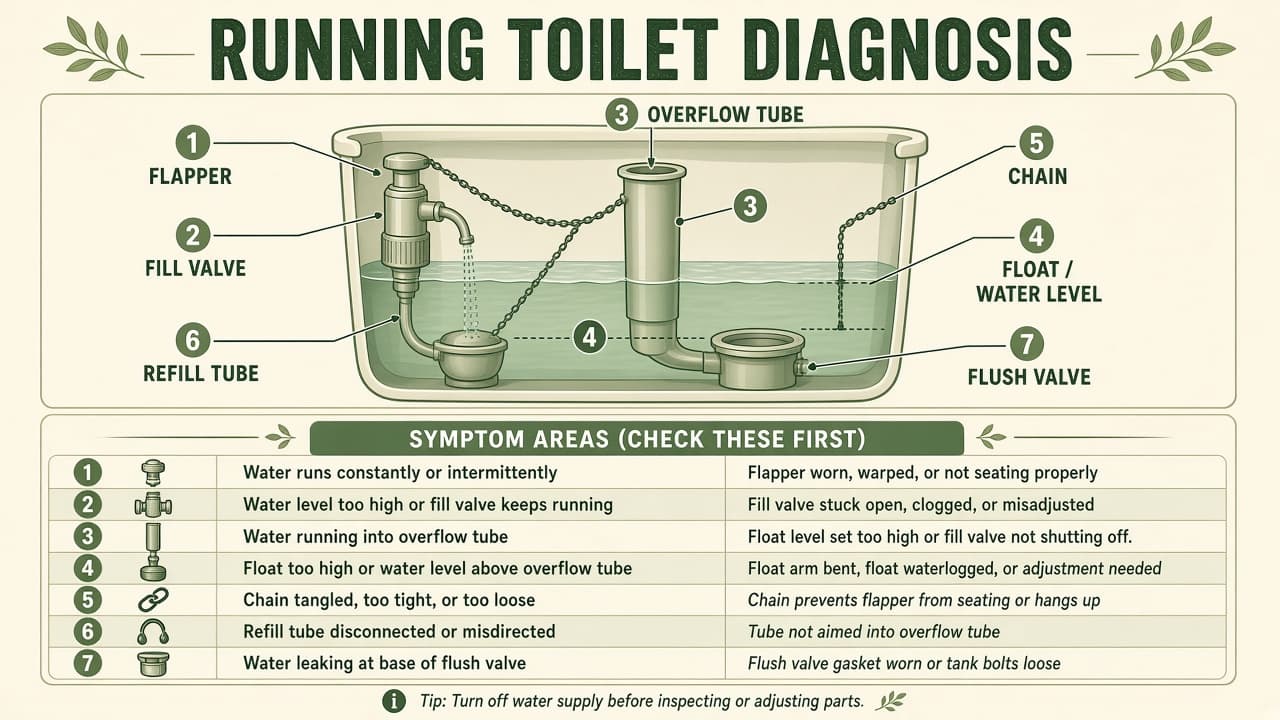
A toilet keeps running because water continues entering the bowl or overflow tube after a flush. Most often the cause is a worn flapper, misadjusted float/water level, or faulty fill valve. Use the symptom table below to identify the part—then open the matching repair guide. This page is diagnosis only.
If you hear water long after a flush—or your water bill jumped—start in the tank. Do not guess and replace every part at once.
Repair routes once you know the cause:
- Full walkthrough → how to stop a running toilet
- Flapper only → replace toilet flapper
- Fill valve → toilet fill valve replacement
- Level only → adjust toilet water level
Symptom | Likely cause | First check
| Symptom | Likely cause | First check / next guide |
|---|---|---|
| Quiet trickle into bowl; dye test fails | Worn flapper or dirty flush-valve seat | Replace flapper |
| Flapper won't sit flat | Chain too tight/tangled or handle binding | Adjust chain slack; free handle |
| Water spills into overflow tube | Float/water level too high | Adjust water level |
| Valve never stops; humming; overfills | Bad fill valve | Replace fill valve |
| Refill tube sprays outside overflow | Misaimed refill tube | Clip tube into overflow |
| Handle sticks / won't return | Bent handle arm or chain catch | Adjust or replace handle assembly |
| New flapper still leaks | Damaged flush valve seat | Clean seat; plumber if cracked |
| Water at base of toilet (floor) | Wax ring / supply—not a “running” tank | Toilet base leak |
The refill cycle (30 seconds)
- Handle lifts flapper → tank water enters bowl
- Flapper drops → seal should hold
- Fill valve refills tank → float rises → valve shuts off
A “run” means the flapper never seals (step 2) or the fill valve never stops (step 3).
Diagnose in order
1. Listen and look
Remove the tank lid. Flush once. Watch whether the flapper fully closes and whether water climbs into the overflow tube.
2. Food coloring (flapper) test
Add dye to a filled tank. Wait 15 minutes without flushing. Color in the bowl = flapper/seat leak.
3. Overflow check
If dye stays in the tank but running continues into the overflow tube, lower the float / water level—or replace a fill valve that will not shut off.
4. Confirm shutoffs work
Before removing parts, turn the toilet shutoff. If it will not close, use the main water shutoff.
Parts map (what you’re looking at)
| Part | Role |
|---|---|
| Flapper | Seals flush valve opening at tank bottom |
| Flush valve / seat | Opening the flapper covers |
| Fill valve | Refills tank after flush |
| Float | Tells fill valve when to stop |
| Overflow tube | Safety path if tank overfills |
| Refill tube | Sends water into overflow to refill bowl |
| Chain / handle | Lifts flapper |
Why it runs randomly or at night
Intermittent running is usually the same tank parts—a flapper that barely seals, a float set at the edge of shutoff, or a fill valve that drips after pressure changes. Watch one quiet cycle; timing alone does not change the diagnosis.
When this is not a tank problem
Water pooling at the base is not a running tank—see toilet base leak diagnosis and plumber vs DIY.
Next step
Identify the row in the symptom table, then open that repair guide. Prefer one targeted fix over replacing every tank part.
Frequently asked questions
- How do I know if my toilet is leaking silently?
- Add a few drops of food coloring to the tank. Wait 15 minutes without flushing. Color in the bowl indicates water is passing the flapper seal.
- Can a running toilet fix itself?
- No. Mechanical wear or misadjustment won't resolve on its own and will typically worsen, wasting more water over time.
- Is a running toilet a flapper or a fill valve?
- Color in the bowl after a dye test usually means the flapper or flush-valve seat. Water spilling into the overflow tube or a valve that never shuts off usually means float adjustment or fill-valve replacement.
- Should I shut off water before diagnosing?
- You can watch one flush cycle with water on. If you will remove parts, shut off the toilet supply valve—or the main shutoff if the local valve fails.
Sources & references
Related guides
How to Stop a Running Toilet (Step-by-Step)
Toilet still running after a flush? Usually a worn flapper or fill valve. Diagnose the cause, fix it in under an hour, and know when to call a plumber.
How to Replace a Toilet Flapper
Worn flapper? Match the type, set chain slack, run a leak test, and know when the fill valve—not the flapper—is the real problem.
How to Replace a Toilet Fill Valve
Replace a toilet fill valve step by step—diagnose a valve that won't shut off, install a universal kit, set water level, and fix a toilet that still runs.
How to Adjust Toilet Water Level in the Tank
Set the correct toilet tank water level for ball floats and cylinder floats, fix overflow tube spillover, and know when adjustment isn't enough.
This guide is for general informational purposes. Conditions vary by home, local codes, and equipment. See our disclaimer.